

 ITALIANO
Health topics
Thyroid disorder: the major effects of a small gland
Located at the base of the neck and controlled by the pituitary gland, the thyroid regulates essential functions: metabolism, body temperature, heart rate, digestion. When it malfunctions, what signs should alert you? How is the diagnosis made and what treatments can restore balance? MonacoSanté keeps you informed.
Understanding the hormones
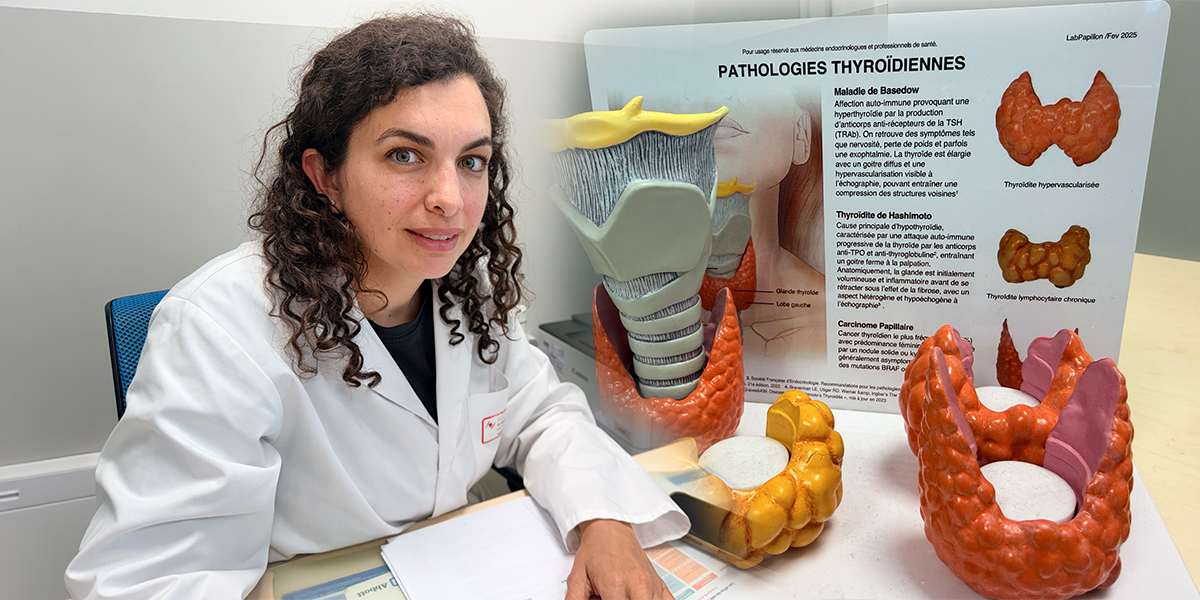
TSH, T3, T4: terms that anyone concerned with thyroid disorder These are the main hormones involved in its functioning: TSH for thyroid-stimulating hormone, a hormone secreted by the pituitary gland, another gland in the brain; T3 for triiodothyronine; and T4 for thyroxine. "The role of TSH is to regulate this organ", explains Dr Annabelle Naman, endocrinologist at Princess Grace Hospital. "In the vast majority of cases, we are born with a thyroid. Over time, it can begin to function too much or too little Fatigue is one of the most common symptoms in cases of hypothyroidism or strong>hyperthyroidism. This malfunction occurs because of the production of antibodies linked to an autoimmune disease that will act on this organ and inflame it". Butterfly-shaped, this gland measures between 5 and 20 cubic centimetres. "When it exceeds 20 cubic centimetres, we speak of goitre". Energy expenditure is directly influenced by these different hormones. Weight loss or weight gain can therefore accompany hypothyroidism or hyperthyroidism. "However, it is important to clarify that these variations generally remain moderate. Thyroid disorders alone do not explain major weight variations", the specialist emphasises.
The most common symptoms
Hypothyroidism occurs when the gland functions slowly. "In this case, fatigue, sensitivity to cold, constipation or weight gain are frequently and progressively observed". Conversely, in the case of hyperthyroidism, the body accelerates due to an excess of hormones. "Common symptoms occur more suddenly: nervousness, palpitations, trembling, diarrhoea and weight loss". It is however possible to suffer from a thyroid disorder without presenting symptoms. "This is fairly common", confirms the doctor. "We then speak of subclinical or atypical forms. In these situations, abnormalities are visible in the blood test, particularly at TSH level. In the absence of significant symptoms, simple monitoring may sometimes suffice. The decision depends however on the clinical context".
TSH blood test as the reference examination
When asked whether there are at-risk profiles, the endocrinologist is clear: yes, women are more affected than men. "The risk is also higher in cases of family history or autoimmune diseases such as Hashimoto's thyroiditis or Graves' disease. Taking medication such as amiodarone, lithium, or an iodine imbalance can also disrupt its functioning", adds Dr Naman. To evaluate a patient, the reference biological examination remains a TSH blood test. "Depending on the results, we can supplement with T4, sometimes T3, as well as antibodies to look for an autoimmune origin. Sometimes, an ultrasound scan can also be useful", details the endocrinologist. The interpretation is based mainly on the TSH level in the blood. "It functions according to a regulation system called negative feedback. A high level points towards hypothyroidism. Conversely, a low level suggests hyperthyroidism". Can one live with an untreated thyroid disorder? What are the risks? "In the long term, the consequences can be serious. Indeed, heart rhythm disorders can occur, as well as cardiovascular complications or even bone fragility, particularly in cases of hyperthyroidism".
Increased risks for pregnant women and their baby
Thyroid malfunction must be taken particularly seriously during pregnancy. "During the first months, the foetus depends on its mother's thyroid hormones A poorly controlled disorder can increase the risks of neurodevelopmental impairment and miscarriage, and impact cognitive development. This is why screening and close monitoring are recommended in women at risk". In patients already treated for hypothyroidism, the need for thyroid hormones increases as soon as they become pregnant, which requires adjusting the treatment. "Their TSH level will be monitored regularly. There is no contraindication to taking it during pregnancy", reassures the specialist. "After birth, we reduce it and patients return to the usual doses".
Treatments based on synthetic hormones
Depending on the disorder identified, the management differs. In cases of hypothyroidism, the reference treatment is based on levothyroxine, a synthetic hormone equivalent to T4. "Although very effective, this does not completely reproduce the complex physiological regulation of the thyroid", warns Dr Naman. "This could explain the persistence of symptoms in some patients. These situations are still being studied and require individualised management". In hyperthyroidism, the aim is to inhibit hormone production through synthetic antithyroid drugs (carbimazole, thiamazole, etc.). "Normally, most patients feel better after taking the treatment regularly". Medical monitoring remains essential, with an annual check of the TSH level, or more frequently if necessary. As a first step, in cases of suggestive symptoms, a consultation with a general practitioner is recommended. A blood test will allow TSH to be measured. Depending on the result, the general practitioner will refer to the specialist.
Restoring balance
Referral to an endocrinologist is made in particular in cases of discovery of a thyroid nodule. "They are extremely common. One can live with them for a lifetime without them developing. In 95% of cases, these are benign. The objective is to detect thyroid cancer. We only operate when they cause discomfort or a risk of thyroid cancer". Thyroid fine-needle aspiration can then be performed when a nodule presents suspicious characteristics. Small in size but essential to the body's balance, the thyroid reminds us that a malfunction, sometimes subtle, should never be neglected. Persistent fatigue, unexplained weight variations or heart rhythm disorders: listening to the body's signals remains the first step towards early diagnosis and often towards a lasting return to balance.