
 ITALIANO
Health-care providers
What is orthoptics?
Screening, rehabilitation, readjustment and optimisation of visual functions: orthoptics is playing an increasingly important role in eye-care management. Accessible at all ages, it provides an effective approach to strengthening neurovisual abilities and improving everyday visual comfort. MonacoSanté has all the information you need.
Assessing and treating functional vision disorders
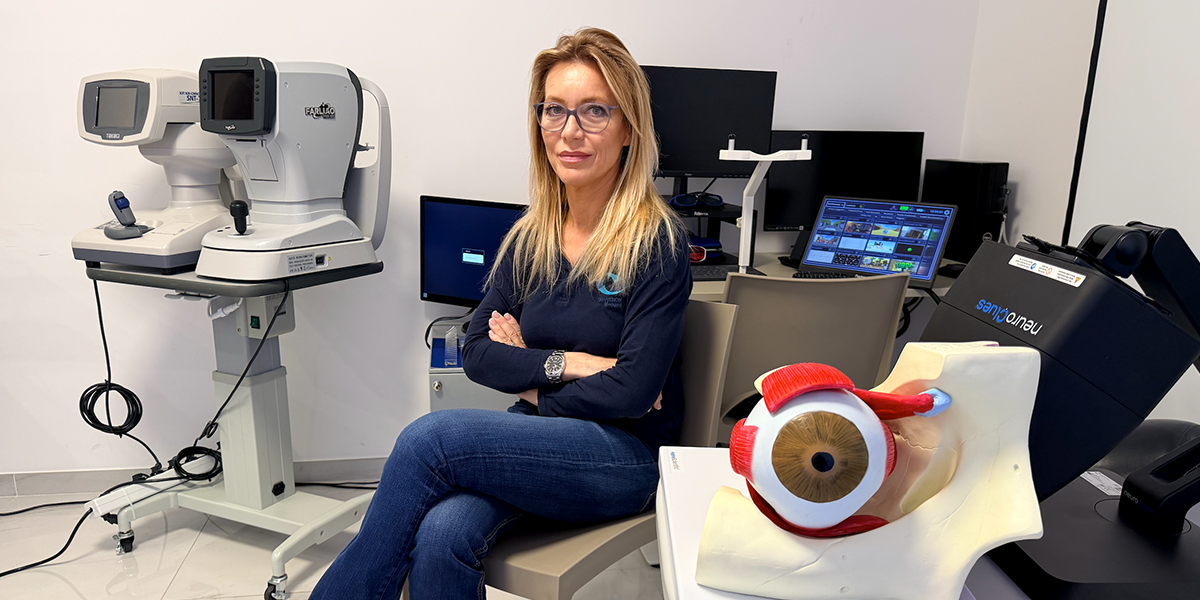
At a time when our eyes are under greater strain than ever, orthoptics offers effective solutions for preserving visual balance. Having practised this paramedical profession in the Principality for 29 years, Faustine Lepoivre has seen her scope of expertise expand. “Our work ranges from infants to older adults and is carried out exclusively on medical prescription. All procedures are reimbursed by the Monegasque and French social security systems, with the exception of elite athletes, as this falls under optimisation rather than medical care,” she explains.
In practice, orthoptists are able to screen for, rehabilitate, readjust and even optimise functional vision. Orthoptic and/or neurovisual care can treat a wide range of conditions, including strabismus, refractive errors (vision defects requiring optical correction such as myopia, presbyopia or hyperopia), oculomotor paralysis causing double vision, convergence insufficiency and visually induced dizziness. It also addresses amblyopia—when vision in one eye develops less effectively than in the other—as well as neurovisual disorders responsible for learning difficulties in reading, handwriting, mathematics or copying tasks.
“As the only profession specialising in oculomotor function, orthoptics also makes it possible to detect neurodegenerative diseases such as Parkinson’s disease or multiple sclerosis at an early stage. By recording eye movements using state-of-the-art tools, abnormalities can be identified almost five years before the first functional symptoms appear,” adds Faustine Lepoivre.
What is the difference between an orthoptist and an ophthalmologist? The former, a paramedical specialist, assesses, rehabilitates and treats functional vision disorders, “from the eye muscles through to the brain, the centre of perception.” The latter is a medical doctor responsible for diagnosing and treating organic eye conditions affecting the lens, cornea, retina or intraocular pressure. “The two specialties are complementary,” stresses Faustine Lepoivre
From assessment to follow-up: how an orthoptic session works
Patients consulting an orthoptist all follow the same care pathway. “The first step is to carry out an assessment in order to establish a detailed medical history: we review the patient’s functional symptoms, listen to their history, and check any optical corrections to determine whether they are suited to their everyday visual demands”, explains Faustine Lepoivre.
The healthcare professional then assesses binocular vision, that is, whether both eyes work effectively together. This is a key factor in evaluating visual endurance and clear vision at each fixation distance. Neurovisual visuomotor abilities are also examined.
“In everyday life, what we focus on must take precedence over moving peripheral vision, even though peripheral vision is also necessary to move around and orient oneself without falling or hitting obstacles. When this balance is disrupted, patients may experience daily instability with vertigo-like sensations”, explains Faustine Lepoivre. Once this assessment has been completed, orthoptic or neurovisual rehabilitation may be proposed. The former generally requires 12 to 20 sessions lasting 20 minutes each, while the latter is delivered over a longer period, in cycles of 20 sessions lasting 40 to 45 minutes each.
These assessments are crucial, as they make it possible to exclude certain patients who could experience adverse effects. “For example, when the visual axes of both eyes do not correspond, what we call abnormal retinal correspondence, rehabilitation must not be undertaken, as it could result in double vision. We also cannot intervene in cases of traumatic neurological paralysis”.
Virtual reality and Eye-tracking: cutting-edge technologies serving orthoptics
After pregnancy, general anaesthesia, whiplash, or as a result of osteopathic manipulation or the use of anxiolytics and/or sleeping pills, some patients who have previously undergone orthoptic rehabilitation may experience decompensation. Further sessions may then be considered. “I teach them simple exercises, as a fusion reflex has already been developed. However, these exercises should not be performed systematically on a daily basis, as this could lead to spasms”, explains the specialist. In young children, only the rehabilitation-based treatment of amblyopia and strabismus is possible. Passionate about her profession, Faustine Lepoivre highlights the growing importance of cutting-edge technologies in screening and rehabilitation, offering greater reliability and comfort for patients. “In paediatrics, we now have access to much more modern and faster tools for visual and strabismus screening”. In particular, she uses eye-tracking—also known as oculometry—a system capable of tracking eye movements using micro-cameras that analyse pupil movements. “In oculomotor and visuo-neurological assessment, eye-tracking has revolutionised our practice: the oculometric profile can reveal attentional difficulties in children, visuospatial impairments, or provide early orientation towards specific written language disorders”. In school health services, teachers and speech therapists refer children presenting learning difficulties. “We carry out two-hour assessments. This allows us to quantify everything and precisely identify what is not functioning correctly”.
Orthoptists also use immersive virtual-reality rehabilitation software. “This makes it possible to work in a more ecological environment, sometimes standing, in motion, and recorded by a camera”. Virtual reality is also used to support older adults.
For elite athletes: enhancing performance
“Orthoptists now work with many more practitioners than in the past”, notes Faustine Lepoivre. Paediatricians refer their young patients for visual and strabismus screening in infants and children.
General practitioners suggest it for patients suffering from headaches and visual symptoms. ENT specialists do the same when dealing with vertigo and sensations of imbalance. Podiatrists and physiotherapists refer patients for postural disorders. Lastly, neurologists may recommend this approach in cases of stroke, Parkinson’s disease, Alzheimer’s disease, traumatic brain injury and concussion. More recently, Faustine Lepoivre has also applied her expertise to elite athletes in order to optimise their visual performance. “With their expertise, neuroscience knowledge and state-of-the-art equipment, orthoptists can assess an athlete’s visual and neurovisual abilities and then propose optimisation programmes to enhance performance”. In Monaco, this approach has already attracted racing drivers, footballers and tennis players. There are currently three self-employed orthoptists practising in the Principality. All have been trained at a university-based school of orthoptics within a faculty of medicine, completing three years of study, hospital placements and a final dissertation.